
Roots Tourism: Matera and Basilicata protagonists with Roots-IN 2025

Redazione BTM
- 19/11/2025
Roots tourism, Italy tells its story in Matera with Roots-IN, the International Roots Tourism Fair.
Now in its IV edition, this year the event has sparked a debate around the theme “Connecting Communities”. The event, promoted by APT Basilicata on behalf of the Region, with the patronage of the Ministry of Foreign Affairs, ENIT, and the Municipality of Matera, and in partnership with RAI, ITA Airways, Puglia Airports, and TTG Italia, aims to promote and facilitate among Italian and international tourism operators the culture of Roots Tourism, with the goal of developing return trips to the roots by creating specific proposals for this type of traveler.
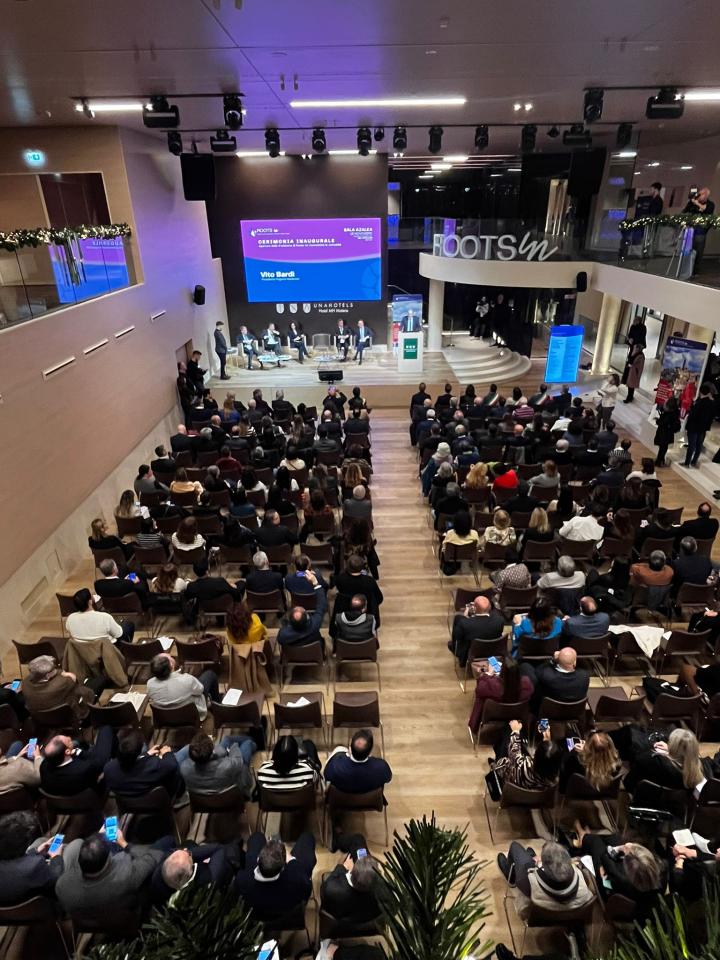
Yesterday, at the opening ceremony, numerous authorities participated, with remote interventions, including that of the Minister of Tourism, Daniela Santanché, who emphasized in her speech how roots tourism represents “not only an economic lever but also a unique opportunity to enhance our origins and strengthen Italian identity in the world, promoting local typical products”
Hosting the event were the President of the Region Vito Bardi, the President of the Regional Council Marcello Pittella, the General Director of APT Basilicata Margherita Sarli, and the Mayor of Matera Antonio Nicoletti.
The event, promoted by the Region and APT, took place at the Una Hotels Mh Congress Center in the City of Sassi. For the occasion, 70 international buyers arrived in Basilicata to meet 140 Italian sellers to dialogue, exchange experiences, and identify new collaboration opportunities. Among workshops, meetings, and laboratories, Roots-IN confirms itself as a strategic appointment for tourism linked to origins and for promoting Basilicata in the world.
Over these two days, workshops and in-depth sessions alternated on some of the most innovative themes in the sector: from digital marketing to genealogy, from communication strategies to the regeneration of territories. Among the focuses was also the storytelling of Italy through new media and strategies to enhance destinations on blogs, Instagram, and TikTok. A round table on the regeneration of communities through roots tourism was also planned, with particular attention to the role of travel agencies, with a session curated by Fiavet Campania Basilicata, and to the enhancement of experiential paths through quality brands like Matera.Doc, presented by Confartigianato. With Enit, there was also a focus on innovation with workshops on artificial intelligence applied to genealogical research, digital marketing, and the analysis of the behavior of "roots travelers".
“This year’s theme, “Connecting Communities” – declared Bardi – invites us to reflect on what unites us: roots, memory, identity. In Basilicata, a land of emigration and return, this bond is deep and alive. Roots tourism represents a strategic opportunity for Basilicata, with enormous economic and cultural potential, capable of strengthening the ties between Lucanian communities around the world and their territory of origin. It means transforming the journey to places of origin into an experience that inevitably belongs to the future. This path fits into a very favorable national and regional dynamic.”
Roots tourism is now a mature segment, recognized internationally and capable of bringing relationships, investments, and new development opportunities to Basilicata. The work started in recent years is bearing fruit: the image of Basilicata is attracting the attention of tourists from overseas as well. Between 2021 and 2024, arrivals of foreign guests increased from about 61,000 to over 254,000, with an increase of over 300%, while presences grew from 125,000 to over 477,000 (+280%).
Matera is in the spotlight, and with it, the entire territory.
“Matera has now become a solid destination – commented Margherita Sarli, APT Basilicata general manager – on the same level as other European capitals. For this reason, it is very easy to bring international experiences and events here, also because its notoriety goes beyond logistical and organizational aspects where there might be critical issues. And I add that the recognition as Mediterranean Capital of Culture and Dialogue is a title rich in content, marking the maturity of a city that until a decade ago did not have this self-awareness, far from being the icon of tourism that today drives Basilicata. And it is from here that, in my opinion, we need to think, with maturity, to better organize the destination and to contaminate the rest of the territory, so that we can increasingly consolidate not only a tourism made of numbers but above all a qualitative tourism.”