
Federterziario at BTM Italy 2026, human capital is the true lever of digital innovation

Redazione BTM
- 02/03/2026
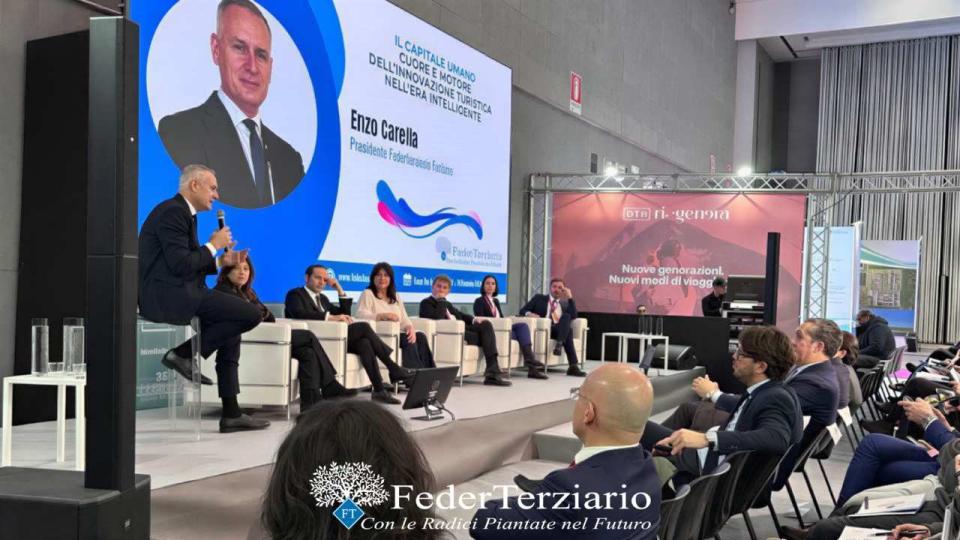
BARI – Tourism as a strategic industry of the country, but above all as a system that thrives on people, skills, and vision. This was the guiding thread of the conference “The human capital, heart and engine of tourism innovation in the smart era”, organized by Federterziario as part of BTM Italy 2026, currently taking place at the Fiera del Levante. During the panel held in the Main Arena of BTM Italy 2026, the institutional greetings were given by Giuseppe Mallardo, president of Ebintur, and Pietro Petruzzelli, councilor for Local Development and Blue Economy of the Municipality of Bari.
At the particularly well-attended conference, moderated by journalist Barbara Magnani, speakers included Eugenio Di Sciascio, councilor for Economic Development and Labor of the Puglia Region, Maurizio Renna, head of the Innovation Department of Federterziario, Alessandra Ricciardelli, associate professor of Business Organization at Universitas Mercatorum, Alessandro De Florentiis, AI4I Partner Ambassador, and Tiziana Franco, head of the Controls Area of Fonditalia.
Opening the debate was Nicola Patrizi, president of Federterziario, who drew a clear line: “Tourism is a prestigious industry that needs infrastructure, vision, and above all human capital: artificial intelligence can enhance work, not replace it, but it is necessary to invest decisively in training and skills. AI has long been an advanced field of experimentation in our sector”, Patrizi explained. “What remains in difficulty is the investment in human capital, both in quantitative and qualitative terms. The effect of artificial intelligence is not negative: on the contrary, it can enhance the quality of workers, who will be increasingly necessary. It is essential to strengthen the professionalizing channels of education and training, taking into account the impacts and advantages of AI”.
Reinforcing the concept of transversality was also the intervention of Enzo Carella, president of Federterziario Tourism, who broadened the scope of analysis: “It has emerged that tourism is increasingly a transversal element within the skills of a territory, in terms of release, well-being, socio-economic implications, and certainly in terms of development. Quality must be a central element and therefore the training of resources, whether they are those of businesses, entrepreneurs, or political stakeholders, is necessary to ensure that the services provided are increasingly competitive at an international level”, he explained. Carella also reiterated the role of the organization in supporting small and medium-sized enterprises, which represent the backbone of the Italian tourism system.
“We, by definition, offer services and support to small and medium-sized enterprises, which are precisely those that suffer the most from their size and need support to develop their activities in terms of access to credit, training, international competitiveness, and connections with institutions”.
Alessandro Franco, general secretary of Fedeterziario places the importance of growth and investment at the center of the debate: “Structural investments are needed to increase the national tourism potential, starting from infrastructure and transport, to the qualitative improvement of accommodation facilities. There are vast areas of the country still outside the main tourist circuits, despite being of absolute value. Recovering this potential means generating widespread and sustainable development. The AI - continues the General Secretary – does not replace human capital in any way, which remains at the center of the world of work. On the contrary, it enhances it and makes it even more qualified”.
In closing, the head of the Innovation Department of Federterziario, Maurizio Renna, highlighted how strategic it becomes to create a system that connects the various actors of the production system: “What has been said so far highlights the importance of creating strategic and lasting connections between companies that use AI and the companies that create it. A dichotomy that must translate into the search for qualified personnel but also and above all in the training of existing personnel: a continuous know-how that leads human capital to walk hand in hand with innovation.”